miércoles, 8 de junio de 2016

Apollo and Daphne.

Apollo and Daphne


Sculpture Card:


Title: Apollo and Daphne.

Author: Gian Lorenzo Bernini.

Year: 1622-1625.

Style: Baroque.

Technique: Marble.

Location: Galería Borghese (Rome).

General description: Apollo and Daphne is an sculpture made by Bernini between 1622 and 1625 and he used marble. It is baroque and is situated in the galery borghese in Rome. The sculpture shows one man and one women, Apollo and Daphne, that is one mythological myth.


Apolo and Dafne is the piece of art that now I will analyse, his author is Bernini, a very famous baroque sculptor, but he not only was sculptor, he was artist, painter and architect.
The style is baroque, this we can see in the expressions of the Apollo and Dafphe, especially in her.
The Baroque was a period of history in western culture originated by a new way of conceiving art and , starting from different historical and cultural contexts , he produced works in many artistic fields, for example in the sculpture. The baroque was established in Europe at the beginning of XVII century.
For that time was a bad period for the society but not for the culture of course.


This sculpture is a group of figures which represent one episode of Ovid's Metamorphoses, Apollo and Daphne.We could see that Daphne is transforming in a laurel, the same that mythological story and Apollo is catching her.
The technique used it is marble and the volumetric form is with diagonal lines for example in the arms.
The effects of lights are from upward to backward, as the sun light.
Is a mythological sculpture, more typical of renaissance and the figures are so realistics and naturalism, a characteristic of baroque.
This sculpture is a very famous sculpture from Bernini, the best italian sculptor from baroque, but also It was other good sculptors like Juan Martinez Montañes a spanish woodcarver or Francois Duquesnoy a sculptor classical style marble,stone and bronze .


In my opinion, Bernini is one of the greatest sculptors of all time because watching his piece of art, we could see the expressions and the naturalism,like in this piece, and this, reflected is marmol, it is so hard and so difficult, and for me he has enormous merit also, the proportions are very good.

domingo, 5 de junio de 2016

The sacrifice of Isaac.

Sculpture card:
Author: Alonso Berruguete.
Year: 1523-1532.
Style: Spanish Renassaince.
Technique: gilding technique.
Location: Cultural Museum of Sculpture in Valladolid, Spain.
General description: This sculture its represents when Abraham will kill his son Isaac.


The sacrifice of Isaac is a sculpture made of wood painted by artist Alonso Berruguete in 1526 for the altarpiece of San Benito Monastery in Valladolid.
Alonso Beuguete came from a family of artists, her father was a famous painter and Alonso was trained as a sculptor and as a painter in the family workshop. He traveled to Italy to continue his his training, when he retur to Spain made some important works like the martydom os San Esteban.

Berruguete in the sacrifice of Isaac, chooses the right moment of maximun tension when the father is about to kill his son, also is impotant to observa that in this work does not efer to the angel sent by Yahvé to stop the father, so the images have a force of impressive expresions.
The form of this sculpture are manierist. Berruguete has echoes of the work done by the same subject, notwithstanding the spanish figures acquire greater stenght and expressiveness perhaps influenced by the discovery at the time of hellenistic sculpture of Laocoon.

 The characters wear light clothes decorated with the technique of gilding showing much of their naked body where the artist highlights a natural figure, the canon is enlogated own manierism and twisted into grimaces of terror Isaac and pain Abraham.


El entierro de Cristo.


EL ENTIERRO DE CRISTO


Sculpture Card:

-Name: El entierro de Cristo.
- Author: Juan de Juni.
- Year: 1541-1545.
- Style: Renaissance.
- Technique: Sculpture carved in wood.
- Location: National museum of sculpture of San Gregorio in Valladolid(Spain
- General description: El entierro de Cristo is a sculpture that represent the burial of Christ with 7 different sculptures. In the centre Christ is situated and other 6 people are near. The thematic obviously is religious.


El entierro de Cristo of Juan de Juni is a renaissance sculpture. The renaissance was the period in Europe from 14th to 17th century, one of the characteristic to establish renaissance in Europe was the humanism, specially the anthropocentrism, a idea that the human is the centre of the universe and not God, although this sculpture is a religious , is from the renaissance in Spain. In Spain the renaissance was established some years later respect other places of Europe, for example Italy, also Spain have not got some renaissance pieces of art because the gothic was established very strongly, for the catholics kings.


The form used in this sculpture is a group of people that are adoring to Christ
As Juan de Juni was a sculptor that used normally the wood, this sculpture is a wood sculpture. Also the form is cuadrangular with some people kneeling and other people up.
The lights are from upward to backward, simulation the sun and in front of Christ.
It is formed by polychrome wood.
The function is religious and the subject matter is the bible, a situation that the burial of Christ.The figures try to be realistics and it be but other sculptures are more realistics.
Other good spanish sculptor are Vasco de la Zarz, Felipe Vigarny or Bartolomé Ordoñez.


This sculpture is very nice sculpture but I prefer other types of sculpture like The Piety, David…, italian sculptures because are more realistics and in my opinion more difficult to make.

El Escorial

 EL ESCORIAL


BASIC INFORMATION 

Author: Juan Herrera
Title: El Escorial
Year: 1563-1584
Style: Spanish Culture
Technique: Sand, lime, granite, slate, marble and bronze
Location: Madrid
General Description: El Escorial is a monastery devised by Felipe II and his architect Juan Bautista of Toledo.

This is the monastery of San Lorenzo of El Escorial. The architect is Juan Herrera. Juan Herrera was an architect, mathematician and geometrician. One of the most outstanding Spanish architects in the 16th century. He represents the peak of the Renaissance in Spain.
Their works were: Monastery of San Lorenzo of El Escorial, Cathedral of Valladolid, Royal Palace of Aranjuez and Archivo General of Indias. His most important work was El Escorial, that he ended in 1584, after reorganizing the original project of Juan Bautista of Toledo. Later, Felipe II, commanded the Cathedral of Valladolid and it was to be the largest cathedral in Europe. 

The style is Spanish Culture. The construction is in 1563-1584. 
El Escorial is a royal palace, a basilica, a cemetery, a library and a monastery. It was built with sand, lime, granite and slate. Marbles figures in Toledo and bronze in Milan.
This monastery is in Madrid. 

The plant is rectangular with four cornes towers. That is common in the Castilian fortresses of stone, classic Italian architecture in the basilica and the covers. The roofs made with slate. 
The sections of the building are: the library, Palace of Felipe II, basilica, crypt, reliquaries, convent, main staircase, chapter houses, hall of battles, museum of architecture and gardens of the friars.

I think that El Escorial is one of the best monasteries of Spain. I like it because now is a museum and you can visit all.

jueves, 2 de junio de 2016

    palace of Carlos V


The palace of Charles V of Granada, independent community of Andalusia, Spain, is a Renaissance building situated on the hill of the Alhambra. Since 1958, it houses the Museum of Fine Arts in Granada and, since 1994, is also home to the Museum of the Alhambra.


It was built by King Charles I (Holy Roman Emperor with the name of Carlos V) from his marriage to Isabel of Portugal, held in Seville in 1526. After the wedding, the couple was living several months in the Alhambra, being deeply impressed by the palace, leaving commissioned the construction of the new palace with the intention to establish residence in the Granada Alhambra.

In the sigle 16th is the sigle when this happen, in tis sigle kings Charles I and Felipe II.

Charles I have a lot of domestics problems and with others countries. Felipe the same at Charles.

In this sigle there was a Religious revolt of Luterans but this was a century with a lot of riches of the Americas.


The floor of the palace the forms a square of 63 meters side with a circular courtyard inscribed inside. This provision, mannerist main feature of the palace, is unprecedented in Renaissance architecture and construction located in what is considered the artistic vanguard of the moment. The building consists of two levels: the bass is fully padded Tuscan order, whose pilasters decorated large brass rings are inserted. The top floor is Ionic and pilasters alternating with lintel openings provided with pediment.

On the inside we can see that is also divided into two floors subject by a doric colonnade on the first floor and the second an Ionic colonnade.


miércoles, 1 de junio de 2016

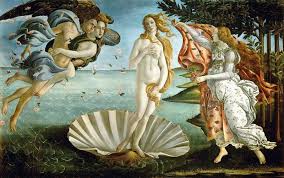
The Birth of Venus.

PAINTING CARD:
Title/Name: The Birth of Venus.
Author: Botticelli.
Year: 1484
Style: Renaissance.
Technique: tempera on canvas.
Location: Gallery Uffizi, Florence, Italy
General description: 
This is The Birth of Venus, this paint represent the summit work of Sandro Botticelli.
Sandro Botticelli was a painter of the Italian Quattrocento. This painting has a mitology theme, that show the birth of Venus the goddess of love. The work was realized between 1484 and 1486.
The painting was making about tempera on canvas. The light is similar in all the work, but in the sea look like more like that was maked with the white. In the middle of the painting we can see Venus, to her right was a pair formed by Céfiro and his wife Cloris and to her left the Hora Primavera.
Botticelli used black lines marking the outlines of the figures protagonists and uses soft and almost uniform to provide an air of unreality to the canvs light colors.
Also we can see a contrast to thr pallor of Venus and the other two female characters with darker skin of the male character. The figures are modeled surface and are somewhat flat, with slender bodies and poor muscle development.
The composition of the work was dynamism, movmente and tension in the scene. This picture has the historical function, because show part of the histoy of mitology.
All the painted include the historical, the mitology, the landscape, the portrait, the genre.
The landscape is one of this subject matter, because the scene happens in the sea, the portrait show the four people with details and the genre is important because appear one man between the three womans. 
The figures are idealised that provide a deep lyricism to this picture.
This work show and represent the birth of the Venus, that was good because the history about the picture are interesting and you learn about the mitology and about the art of the 15th period. 


martes, 31 de mayo de 2016

San Lorenzo. Brunelleschi


Arquitectonic card:
Title/name: Church of San Lorenzo.
Author: Filippo Brunelleschi.                 
Year: 1422-1470.
Style: Renassaince. 
Technique: Stone and marble.
Location: Florence, Italy.
General description: Italian basilica of catholic cult.
                                
                
This is the church of San Lorenzo, that was contructed by Filippo Brunelleschi. Filippo Brunelleschi was an architect and italian sculptor. It was the most important sculptor in the 15th century, with Alberti, Donatello and Mosaccio. He is one of the developers of Renassaince style. All their mathemathical knowledge and his enthusiasm for this science that help to Filippo to takeit for the discovery of the perspective, the key of the Renassaince art.


The Renassaince style is a cultural movement that was produced in Western Europe during the 15th and 16th century. The city of Florence, in Italy was the place when this movement born and was development and then was extended of the rest of Europe.
In 1422-1470 was the period that during the construction of this church. The construction can be considerate that start in 1418,because before to built this church, some buildings was demolished.
This basilica was ordered to build by Cosme de Médici. Cosimo di Giovanni de' Medici being a politician and a banker, founding of the dynasty of Médici.

This constuction was a church or a basilica, the materials used are the stone, thec marble and other materials for the facing.This church present a basilical plan that have columns and arches. The arches that formed this building are middle point arch.

The nave is a latin cross plan, has ten chapels vaulted four points , which open to area cruise and the transpet.
The side chapels have the same proportion as the arches of the naves and are covered by a barrel vault.
The dome was decorated with Zodiac signs. Brunelleschi designed the sacristy as a surmounted by a hemispherical dome, where the dome is shown as a ray of sunshine were each of the twelve rays represent the twelve apostles cube, this is a way to represent the universe.
Thw walls of the nave have small windows and side oculi , small around windows that give natural light to inside.
For this basilica Brunelleschi created a latin croos plan, with very little cruise,it produced a visual effect of the centralization in the area of the transpet to enter that area in the light of the latern dome.
This is a catholic cult church that are use for the regular worship.
The previus influences was the demolition of some buildings, the following influences was the place of the Médici family grave.
Finally, in conclusion one piece of art are easy to analyse when you folow the phases that you have, these constuction was easy to analyse because you can search some information and make a principal idea about this build and tell the inmportant information about this basilica and learn about the construction of this period an the style.